
Gerrymandering
What is it? How does it work? And what does it have to do with me?

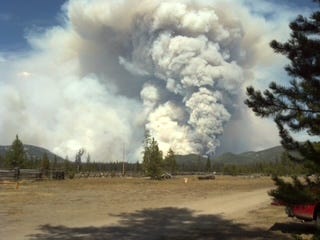
It’s been a while since I’ve published anything. Thanks for letting me have the time to go earn a paycheck. I was on the Goldrun Complex fire – a group (“complex” in fire-speak) of 9 small fires totaling about 34,000 acres near Ambler, AK, about 45 miles north of the Arctic Circle, and then the Middle Mesa fire in northern NM until NIFC, the top echelon of wildland fire suppression coordination, was talked into bringing in a larger, more sophisticated team. Got home a few nights ago where I hope to be for a week or two before getting deployed again. At that, I’ll pull the seasonal fire plug. I might be getting too old for the stress and the long hours.
I don’t go out anymore on a hand crew digging line. That’s for men and women decades younger than I. Eventually almost everyone eventually either bids farewell to fire altogether, or moves up to a “non-arduous” position. I deploy as the guy who manages and coordinates the medical resources that all fires have – EMT’s, paramedics, ambulances, Rapid Extraction rescue teams, helicopters, medical supplies…that sort of thing – not one of the more heroic folks that are humping packs up mountain sides and digging line in 100 degree heat. Sometimes I have no idea how they do it. I usually work out of a cooled or heated yurt and my work environment looks something like this – far from any danger.




Sometimes I have to deal with a couple of troublemakers! It’s a dirty job, but somebody has to do it!

Anyway… since Trump and MAGA gained prominence, I’ve turned to the news every day I’ve had internet or cell service. And I don’t think there has been a day where there are not several references to race on the front pages of the media I turn to…the WSJ, Washington Post, NY Times, and the Atlantic. If you’re wondering why I don’t turn to Fox, here’s why… they simply have no credibility.
The Wall Street Journal has been awarded 40 Pulitzers, 6 Edward R. Murrow awards, and in 2025 alone, the Journal received 13 National Journalism awards.
The New York Times has been awarded 145 Pulitzers, one Nobel Peace Prize, and numerous Edward R. Murrow, Peabody, and other prestigious awards.
The Washington Post has been awarded 78 Pulitzers, 1 Edward R. Murrow award, and numerous other top journalism awards.
The Atlantic, publishing since 1857, has been awarded numerous prestigious awards in journalism including 3 Pulitzers, and 3 National Magazine Award’s top category of “General Excellence”.
Fox News has yet to be awarded any journalism awards.
At any rate… I remember being asked three or four decades ago what the country could do to address its thing with race. I recall naming three things, although I can recall just one. Eliminate Gerrymandering. But what exactly is Gerrymandering, how does it work, and what - if anything - does it have to do with race?
Gerrymandering works by manipulating the boundaries of electoral districts to favor one political party over another. The easiest way to understand gerrymandering is through the lens of two basic techniques: cracking and packing.
Cracking splits groups of enemy voters – voters who will likely vote against the party in power and who is therefore setting up the voting districts – into different districts with as few of the un-favored voters in each district as possible. With their electoral strength diluted, “cracked” groups are unlikely to be able to elect their preferred candidates because they are too small a political share of the gerrymandered district to be effective.
Packing is the opposite of cracking. With packing, map drawers cram members of disfavored groups or parties into as few districts as possible. The packed groups are able to elect their preferred candidates by overwhelming margins, but their voting strength is weakened everywhere else.
Gerrymandering can be categorized into two types:
Political Gerrymandering is legal in many states, allowing legislatures to redraw district lines to benefit the majority party. Courts generally do not intervene in these cases.
Racial Gerrymandering involves manipulating district boundaries to dilute the voting power of racial or ethnic minorities. Unlike political gerrymandering, racial gerrymandering can be challenged in court under the Voting Rights Act. But since the Supreme Court eliminated the pre-clearance requirement of the voting rights act in 2013, it is now significantly easier to create race-based districts.
Back in the good old days, neighborhood maps were hand drawn. But the modern age of computers allows redistricters to know the party affiliation and ethnicity of every household and to literally place a home in one district while the homes on either side are placed in a different district.
Done well, Gerrymandering is a chance to create maps that elect legislative bodies that fairly and accurately represent communities that are, in the words of John Adams in 1776, an “exact portrait, a miniature” of the people as a whole.
Sounds quaint, doesn’t it? That was then. This is now.
Map drawers no longer have to fear judicial intervention. In a 2019 case, Rucho vs Common Cause, the Supreme Court held that while gerrymandering was “inconsistent with democratic principles,” gerrymandering claims were a “political question” beyond the reach of federal courts to address. The majority opinion was written by John Roberts and joined by Justices Thomas, Alito, Gorsuch, and Kavanaugh. Dissenting was Justice Kagan, Ginsburg, Breyer, and Sotomayor.
The Constitution and the Voting Rights Act prohibit racial discrimination in redistricting, even if the Roberts court seems fit to not address it. But because there is often a correlation between party preference and race, especially in the South, the Court’s ruling in Rucho opened the door for states to simply defend racially discriminatory maps on grounds that they were lawfully discriminating against Democrats – who happened to be mostly Black - rather than impermissibly discriminating based on race.
South Carolina offers a vivid example of this dynamic. After the 2020 census, state legislators there redrew the coastal district of Republican congresswoman Nancy Mace to remove large numbers of Charleston-area Black voters. When Black voters challenged the reconfigured district in federal court as an unconstitutional racial gerrymander, lawmakers defended the map based on politics — namely, the desire to make Mace’s highly competitive district more reliably Republican. Targeting Black voters and their political power was just a means to an end. The defendants actually said that out loud – “Yeah, we’re discriminating against Black voters. So?” Yet six Supreme Court Justices agreed, finding that Black voters hadn’t proven that the map’s lines were based on race and not party affiliation even though the defendant had just said so! Justices Kagan, Sotomayor, and Jackson disagreed with the majority decision.
For maybe a week now we have been reading about Texas’s threat to rig the system and redistrict in order to pick up another 5 MAGA seats in the House.
State legislatures normally redraw district lines every ten years after the census as required by the Constitution. But concerned about the deep unpopularity of many of his policies and positions - even immigration - Trump has instructed the MAGA controlled state of Texas to redistrict now, mid-decade, in order to carve up five districts that tend to vote Democratic and create districts that MAGA Republicans will almost certainly win in the 2026 midterm. Five additional seats will help Trump hold control of the House.
Trump is urging other Republican-dominated state legislatures - Florida, Indiana, Missouri, New Hampshire, and Ohio - to do the same thing.
You’ve heard me say many times that America’s Thing With Race affects us all. As you ponder how - or even if - America’s Thing With Race affects you, think about the voting system America has built where instead of you deciding who is going to be your representative, your representative decides who their voter is going to be.
Sources:
https://www.snopes.com/fact-check/fox-news-pulitzer-emmy-peabody/
https://www.brennancenter.org/our-work/research-reports/gerrymandering-explained
https://www.brennancenter.org/our-work/court-cases/rucho-v-common-cause
https://www.brennancenter.org/our-work/court-cases/rucho-v-common-cause
I'm counting on Texas' long-standing tradition of "don't tread on me" to show the Trump administration that he needs to butt out of local politics. I was skeptical that they would do this, but I believe I am seeing a trend in this direction. Texans are a lot of things, but one thing they all agree on is not being manhandled by the feds. This overt "manhandling" has caused a distinct ripple in the conservative, Chrisitan, freedom loving group. I have to admit that I am enjoying watching this unfold.