
THE AMERICAN REVOLUTION
and Mark Codman

Ken Burn’s most recent documentary, The American Revolution, has gotten a lot of press. He’s exposed so much history that few of us, myself included, never knew. Some has to do with race. It’s a challenge to talk about American history and not talk about race. It’s a huge part of who we are. There’s been a lot of pushback to the documentary from the (deeply racist) MAGA crowd, especially Burns’ repeated mentioning of Washington’s path to riches being through slavery – and the wealth he married into – which was also wrapped in slavery. Oh yeah…Martha was really pissed off when George freed his slaves after his death. AFTER his death. He himself did not want to deprive himself of the joys of slavery.
All that got me thinking of Mark Goodman. Like you, I had never heard of Mark until I read a book – one of 21 written by my friend Bill McKibben – The Flag, The Cross, and the Station Wagon – a graying American looks back at his suburban boyhood and wonders what the hell happened. Bill had also never heard of Mark Goodman until he started researching for his book. But it’s a story and a piece of history well worth knowing about…the part of Paul Revere’s famous ride that was not covered in school. Not intentionally not covered, mind you. Your teacher also had never heard of Mark Goodman.
When I was in school American history was taught as a specific narrative – a series of triumphs that we have bragging rights to and that remain front and center over wrongs that were relegated to the distant, unimportant, unspeakable past. We portray that we are an honorable country always marching towards good. Slavery was evil, sure, but the Civil War ended that evilness. Then there was segregation, but America-the-good gallantly addressed that with the Civil Rights movement - and with the help of White people ended segregation and all that had been unfair and un-American. There was no atoning for the near elimination of Native Americans, yet it somehow didn’t invalidate our national narrative of perpetual greatness. Abroad, the U.S. had led the cause of freedom against fascism and communism. At home Japanese internment, McCarthyism, and Vietnam were mistakes but they didn’t erase the larger picture of our greatness. That’s a pretty positive narrative – mostly about the greatness of White men. But it’s a long way from being accurate.
If A graying American looks back at his suburban boyhood and wonders what the hell happened sounds boring, it’s not. What it actually is – at least the first of the three chapters (The Flag chapter) – is one of the best coverages of America’s Thing With Race I have ever read. Get the book. And if you want to fully and completely understand why your kids cannot buy a house anywhere near the pleasant town that you live in, read pages 15 – 85. It’ll take all of maybe 90 minutes. I do struggle a little about being annoyed – mostly at myself - that such a good analysis was written by a White guy. But I do say and believe that our national thing with race knows no racial boundaries.
Bill McKibben: “Mark Codman was a name I hadn’t ever heard before. I learned it only because I was rereading Paul Revere’s account of his famous midnight ride to Lexington, which contains this passage describing his near apprehension: ‘I set off upon a very good horse; it was about 11 o’clock, and very pleasant. After I had passed Charlestown neck, and got nearly opposite where Mark was hung in chains, I saw two men on horseback under a tree. When I got near them I discovered they were British officers. One tried to get ahead of me, and the other to take me. I turned my horse very quick, and galloped towards Charlestown neck, and then pushed for the Medford Road. The one who chased me, endeavoring to cut me off, got into a clay pond, near where the new Tavern is now built. I got clear of him, and went through Medford, over the bridge, and up to Menotomy.’
The part of the story that struck me was that phrase ‘nearly opposite where Mark was hung in chains.’ Clearly it was a well-known landmark, since Revere just mentioned it casually in passing, but signifying what? Signifying, it turns out, altogether too much. Mark Codman had been enslaved. He and his sister Phyllis were owned by a sea captain named John Codman who was by all accounts a brutal master. Brother and sister suffered long enough that in 1775 they resolved to kill their owner – not to escape slavery, but in order to get ‘another master.’ Mark was afraid of sinning; he read his Bible and concluded that if he could kill his tormentor without actually shedding blood, he would have avoided the letter of the holy law. He obtained arsenic from a doctor on the pretense he would use it to kill pigs; instead he and his sister poisoned the tea and porridge of John Codman until he died.
He and Phyllis were tried and convicted, not just of murder, but petit treason, the first time such a charge had been laid in Massachusetts. Her punishment; she was burned alive. His sentence was almost as grim. After being hanged and tarred, his body was gibbeted. Do you know about gibbeting? I didn’t. It means locked in a human – shaped iron cage, and then hung in a public place as a warning – sometimes alive, there left to die of starvation, and sometimes, as with Codman, after execution. Gibbeting was fading away in England - among other things, surgeons wanted dead bodies for dissecting - and was largely unknown in Massachusetts. But the crime of a Black man murdering his owner was evidently so unsettling that Mark was not only stuck in a cage on a pole – he was left there for decades. By the time Revere rode by him in 1775, Mark had been there for 20 years; by the time Revere recounted his ride in 1798, more than 40 years had passed and yet he could still assume that absolutely everyone would know just what he was talking about. Mark Codman was part of the New England landscape.
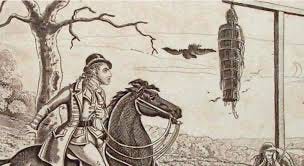
I’m not sure why that story smacked me so hard, but it did. One reason gibbeting was in decline was that contemporary observers complained long and hard about the stink that gibbeted bodies gave off as it decomposed – neighbors said to keep the windows closed for months. The stench still seems pungent to me, scenting everything I like to believe about American history. The line between that iron cage and Derek Chauvin kneeling on George Floyd until he died seems direct, with the same fearful need to drive home the reality of everyone’s real place in our society. Revere’s ride, immortalized by Longfellow, took him beneath the skeleton of a slave, hung for decades from a pole to remind everyone exactly who was in charge. And no one who mattered seem to have thought a thing about it
Once the thread tugging begins, of course, it continues; that is its nature, and before long, your warm and cozy sweater is full of holes.
Consider, briefly, the scholarship that Mary Thompson brought to her 2019 study of George Washington and his slaves. Thompson had started by guiding tourist – sometimes 8,000 a day – at Mount Vernon in 1980. ‘What that mass audience often wants is an answer to the question, ‘Was George Washington a ‘good slave owner? He was good to his slaves, wasn’t he?’ ‘Well yes, that is what we White Americans would like to think.’
Thompson, a careful, nuanced historian – makes quite real both the life of those enslaved people, and the growing intellectual and moral conflict for Washington, the only one of the founding fathers to free his slaves in his will. But her bottom line is clear: ‘Let me just say upfront that some of the worst things one thinks about in terms of slavery – whipping; keeping someone in shackles; tracking people down with vicious dogs; selling people away from their family – all of those things happened at Mount Vernon or on other plantations under Washington’s management.’
As Nicole Hannah-Jones observed in an interview with Ezra Klein of The NY Times in the summer of 2021, ‘George Washington wasn’t moonlighting as a slave holder. It was his career. That was how he gained the resources to go off and do those other great things that we so admire and praise.’
By Thompson’s account, one of Washington’s slaves had taken up with a British prisoner of war, held at Mount Vernon during the revolution, and wanted to return with him to Europe after the British surrender. Washington’s overseers said no. ‘She protested vehemently, so in order to ensure that she understood that she exercised no option in determining her own status, Washington had her branded with a “W “on her cheek.’
Or consider Ben Franklin, up north in Quaker Philadelphia. Following the custom of the day, he retired at 42 to become a gentleman, and perhaps no American has ever made better use of that status; aside from his role in discovering electricity, he invented bifocals, improved street lamps, wood stoves, and odometers, and created the first flexible urinary catheter. He helped pioneer the lending library and the fire brigade; he charted the Gulf Stream; he was the first chess player ‘known by name in the American colonies;’ and he wrote an essay on the morals of the game still read today. His diplomacy in London and Paris was crucial to the outcome of the revolution. The great philosopher Kant called him ‘The new Prometheus.’
But here’s the thing - before he retired, when he was making his fortune editing the Pennsylvania Gazette, every single issue carried ads for slaves, or offering rewards for the capture of runaways. ‘Between one fifth and ¼ of the paper’s advertisements directly concerned slave labor,’ and he often acted as the middleman in the transactions. ‘Two lively young Negroes, one lad about 19, the other a girl of 15, to be sold. Inquire of the printer.’”
George Floyd. His gruesome death and snuff film gave birth to The Civil Conversations Project. The entire country was up in arms. A lot of people thought, “Finally! This is the moment”. The moment when America would finally recognize racism and unite in turning away from it. I was not that optimistic about American’s staying power. We’re famous for our 15 minutes of fame, concern, and protest, before we turn back to Starbucks and our devices. But I thought it was worth a shot. Five years and one month later, I still believe that fighting to end America’s unique form of deadly cancer is worth the shot.
One of this Project’s most prominent supporters brought up the challenge The Civil Conversations Project faces because we don’t have a specific “ask” of people. But that’s not exactly true. We do have an ask. We ask you to participate in moving that dial. I’ve written about that. Learn how deeply America’s Thing With Race is embedded in the fabric and foundation of this still-wonderful country. Understand the erosion it has done and continues to do. And then use that knowledge to motivate and guide you to figure out what you might do. Anything at all that lends assistance to your fellow countrymen – citizens or not, legal or not – moves that dial. If racism is at the root of everything, then anything helps. Support your local foodbank…anything.
It’s easy to sit on our back deck or front porch and think that our national cancer doesn’t really affect you. Easy to think, “Yes, there’s a lot of s*** happening, but at the end of the day, life is good.” But it does affect you. It’s why you don’t want to read the news. It’s why you shake your head in bewilderment and ask, “What the hell has happened to America?” It’s why you have friends who day dream about moving to another country. Our thing with race is the rootstock that everything else is, well…rooted in.
If you have wondered why we call it “America’s Thing With Race” instead of calling it what it is…racism…we do that so as not to make readers bristle, become defensive, and shut down. It’s hard to talk to White Americans about race. Lots of American’s do not believe that racism exists in America in any meaningful way. But do we have a THING? Yeah, that they can swallow. Race in America is a super touchy thing to even talk about. Dwell on that for a moment. Not only do we have a problem, but we can’t even talk about it. Acclaimed actor Morgan Freeman and others have said that the way to end racism in America is to not talk about it. Say WHAT?!? Maybe we can cure cancer or end homelessness while we’re at it.
In her book, Why I’m No Longer Talking To White People about Race, author Reni Eddo-Lodge explains her frustration with White Fragility and trying to move the needle on racial justice. “I’m no longer engaging with White people on the topic of race. Not all White people. Just the vast majority who refuse to accept the legitimacy of structural racism and its symptoms. I can no longer engage with the gulf of an emotional disconnect that White people display when a person of colour articulates their experience. You see their eyes shut down and harden. It’s like treacle is poured into their ear canals. It’s like they can no longer hear us… They’re itching to talk over you but not really listen, because they need to let you know that you’ve got it wrong.”
O, yes,
I say it plain,
America never was America to me,
And yet I swear this oath—
America will be!
Let America Be America Again – Langston Hughes