
THE ASPEN ACRES FIRE
...I’m baaaaack!!!

I feel like I owe you an apology, or at least an explanation for my long radio silence. Most people need a paycheck. I’m no exception. Mine comes from wildland fire. I was deployed to the Aspen Acres fire in the Wet Mountains in south central Colorado about two and a half weeks ago. I no longer do any hero stuff and neither my life nor limbs are ever in any danger. I mention that because I get thanked a LOT when I’m out on a fire.


Mostly the locals of course. My role is to set up and manage the emergency medical component of the fire. There were just under 2,000 people on the fire when I arrived. The ‘Med Unit’ had about 25 of them, four ambulances, two rapid extraction teams with expertise in ropes and high-angle rescues, and UTV’s - large, 4-person ATV’s – to transport victims to a helicopter or ambulance over a road or dozer line too rough for even a four-wheel drive vehicle.


The fire is still burning and as of this morning has consumed some 102,000 acres, displaced over 9,000 people - and bear in mind that’s 9,000 people from a remote, mountainous area, not a large town or city, so pretty much everybody – and destroyed over 8,000 structures. To date American taxpayers have shelled out 87 million dollars on just the Aspen Acres Fire. A huge portion of that is air support – dumping and retardant.
So far, no serious injuries. The four firefighters who were so sadly and tragically burned over and died recently were also in Colorado on the Knowles fire – which as it happened was part of my backcountry patrol area when I was rangering for the Bureau of Land Management, Department of the Interior.
I’ve been on fires where after the first four or five days I’ve gotten my stuff dialed in and had time to work on The Civil Conversations Project. But not this fire. Hence…radio silence. And now here I am, trying to catch up. Maybe a break from the heartache of America’s Thing With Race ain’t a bad thing.


I do not always have the best feelings towards mankind. But it’s also not uncommon for me to be inspired. Several years ago – 2015 to be exact - I was inspired on a fire I was on in Libby, Montana. Fire camps and outpost up on the fire line require a lot of porta-potties. The feds have a standard for everything. Shower units have to be able to generate x gallons of hot water at a specific temperature and pressure. The vendor has to shut down and do a deep cleaning of every shower stall at certain, specific times of the day. The food caterer has to store food at a certain temperature and serve it at a specific temp. Porta-potties have standards that have to be met as well.
They are emptied and scrubbed every day. We all avoid porta-potties when we can, right? But fire porta-potties are clean and orderless. Always. If it were my job to vacuum out human waste into a tank truck and then wash the porta-potty inside and out I’d probably wonder where life had gone horribly wrong. But on the Goat Rock fire in Libby, I witnessed the porta-potty guy – and full disclosure here - he owned the business and was not a mere employee – but he went about his job of sucking up poop and scrubbing the johns inside and out with a pride that was obvious. I was inspired and was reminded that all work is honest work. Well… unless it’s dishonest work.
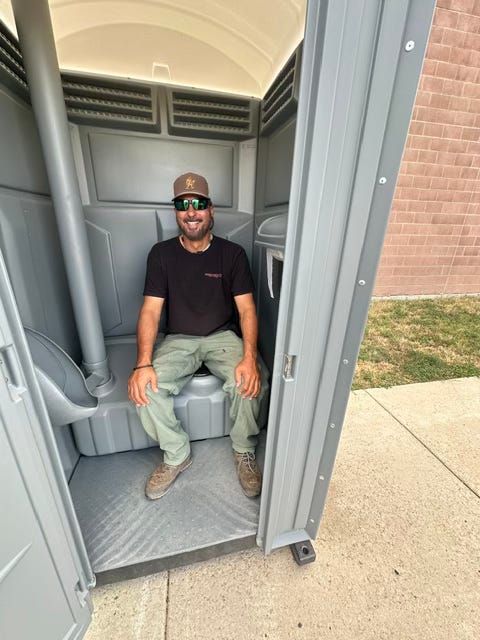
Two years ago I was on a fire in the Trinity Alps in Northern California. Home of Bigfoot, so I stayed on high alert of course. If I manage to die on a fire, I don’t want to be remembered as the guy who got eaten by Sasquatch. Within the chow area that fed probably a thousand people, a young woman had set up a pop-up shelter. After eating, we’d bring our paper plates to her shelter where she’d take the plate, toss the plastic utensils and the meat and scrape the remaining food into a bin and eventually deliver it to an organic hog farm. I’m not sure how that worked, since our food is not organic. And I don’t know who was paying her…the fire or the farmer. But I loved that she was out there making money, employing people, keeping garbage out of the landfill, and performing a valuable service. She and her employees seemed happy and upbeat.
Large fire camps generate a gigantic amount of trash and would-be recyclable material. Sometimes there are recycling barrels. Sometimes, like on the Aspen Acres fire, there are not. And even when there are, I’m skeptical. The recycle bins invariably become contaminated and I’ve never once seen a truck filled with what appeared to be recyclables.
We place thousands of orders, myself included, much of which comes in cardboard boxes. Plastic water and Gatorade-type drinks abound at every camp and vehicle by the thousands. According to NIFC, the National Interagency Wildland Fire Coordinating Center in Boise, 582 fire crews were working today, consisting of 26,036 people. AI calculates that a single crew over the course of the season uses and discards around 50,000 plastic bottles. If there are 582 crews during peak season, I’m going to take a wild guess based on nothing, that the seasonal daily average is 30% of peak season, or 175 crews. If that’s anywhere near accurate, the fire community tosses some 8,750,000 plastic bottles into the land fill every fire season.
So back to the Calf Creek fire in NM. Kinda’ like the food recycling gal above, the Calf Creek had a guy who had a truck who spent his 16-hour days gathering our trash, separating it, and hauling it to some big city recycling center that had to be far away in Albuquerque.
Another person earning a non-standard living, employing people, and supplying a service that was valuable to the planet. Pretty cool. He published his numbers every day. I have no memory of the numbers other than every day we generated WAAAY more cardboard and plastic then I would ever have imagined that ended up recycled instead of in a landfill. Pretty cool, huh?
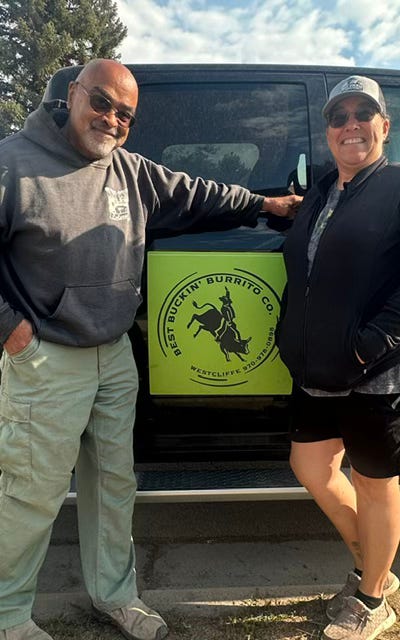
And here on the Aspen Acres the local special ed teacher – who’s class room and desk it turned out I was using – has a side hustle making breakfast burritos and selling them out of the back of her truck. Having a sense of humor and, according to her, a foul mouth, she named her little business, The Best Buckin’ Burritos. And they well might have been the best buckin’ breakfast burritos that I have ever eaten. And firefighters?...she would not take a penny from any of us. Being sneaky, I collected a bit of money for her and left it on her desk.
And truth be told, although I did no Civil Conversations Project work, it’s not like I even have the ability to turn it completely off. Fire has taken me to some beautiful places that I am unlikely to have discovered on my own. For the Aspen Acres we set up two camps. One was in the city of Pueblo Colorado. The other – mine – was set up in Westcliffe, population 505 of which of which 2% are native Americans, 3% are Pacific Islanders, 4% other, 8% Hispanic, and 83% White.
Westcliffe is a picture perfect western mountain town that is the rare, cute Colorado town that has not been discovered and thoroughly ruined by the millionaire and now the billionaire class. Clean. Cute. Just touristy enough to have a couple decent restaurants and art galleries and one bad-ass ice cream shop…I heard. The view of the Sangre de Cristo mountains was one of the best views from town that I have ever witnessed. If I still had 30 or 40 years of life left, I’d be mighty tempted to call Westcliffe my home town. But once again I was not surprised, but befuddled, nevertheless. Almost exclusively White with a few Pacific Islanders thrown in, along with a delightful Dutch Amish community and zero Black Americans.


It seems to me that all the cute, scenic places in America – of which there are thousands - are populated almost exclusively by White Americans. I kinda get it.
A few years ago, after the violence in Ferguson, Missouri, a friend of mine, a brilliant surgeon, told me that if Black people wanted to live better lives, they should move to a better place. I’d heard this sentiment before, always uttered with the unspoken privilege of ignorance that comes with being White. “Why don’t those people make better decisions … like we do?” But it’s not that simple. How to explain? Race is complex.
I think White people assume that the America they experience is the only America. After all, it’s all they know. If White people want to move and can afford to, they just pack up and off they go. But if Blacks want to move to a “better place,” i.e. a White neighborhood, we have to make a different calculation: Will I feel accepted, or isolated? Will I feel … safe? Will my children? How will the police and neighbors treat us? Black Americans’ experience with White Americans and White law enforcement has not always been great. Often it has been life threatening.
Years ago I visited a good friend who was the superintendent of Cuyahoga National Park in Ohio. I hadn’t spent much time in the Midwest. But I’ve been back-and-forth enough to know that it was mostly flat, lots of farmland, and to me, boring. So I was not really prepared for the beauty of the park and I especially wasn’t prepared for the quaint, quiet, leafy little colonial town situated in the middle of the park. I asked my friend, who is Black, if any Black people lived in that town of Boston Mills. He said no. It had once not that long ago, been a stronghold of the KKK. So I get it. I do. Just up and moving for Black people is different than it is for White people. But still…
It’s good to be back. I’ll see you again in a couple of days.
Wayne, you are such a great communicator and I'm always impressed with the things you notice, the people you highlight, the research you do and the facts you come up with that I would never have learned about if not for your writing. This was a wonderful piece that provided insight into the unique world of wildfire fighting that most of us will never experience. It also included an incisive look into an important aspect of America's Thing With Race communicated with grace. Thank-you!
Welcome back!